
Another year, another strategy. Q1 is often the time for setting the direction for where to go and what to achieve. So, we need at strategy. That master plan we can use to guide our ongoing decisions. That aim we can break down to manageable ‘to do’ lists. That roadmap to get the organisation treading in the same direction.
I LOVE strategies. Love organising the chaotic complexity of our goals, our project, our purpose, or our challenges in a neat overview. However, I am not alone in my love for strategies:
- Leadership loves them because they can align on the business priorities
- Management loves them as a direction to navigate by
- Employees love to know and understand what the focus is
- And management consultants love how many potential workshops can be put into a strategy process
Though preparing a strategy varies a lot depending on the level of the strategy and the amount of analysis required, it does not necessarily need to be months in the making. Two years ago, I was advising a client on a strategy development which was completed in just 6 non-consecutive days (In all fairness, not including the many hours of background analysis, student helper proofreading etc.).
Do you want to know how we did it?
Day 1: The ‘how the f… will we ever get there’-day
Few things are as frightening as a blank canvas! So, a way to break away from this paralysing state, we want to start visualising the outcome. Are we in need of three qualified scenarios for the executives to choose from? Are we preparing a 3-year strategy that we then break down year by year, are we strategizing how to realise our project objectives or identifying our must-win battles? Regardless, we need a clear vision of our output first.
So, we draw up a story board. A table of content if you want. But high level on what we would like our final product to include. It might be as simple as three chapters: 1) Background (e.g., bridge to prior strategy, rationale, analysis) 2) Target (e.g., the ambition of the strategy, how we want to achieve it) and 3) Requirements and Recommendations (e.g., implementation scenarios, WBS/Work-Breakdown-structure, Cost estimate).
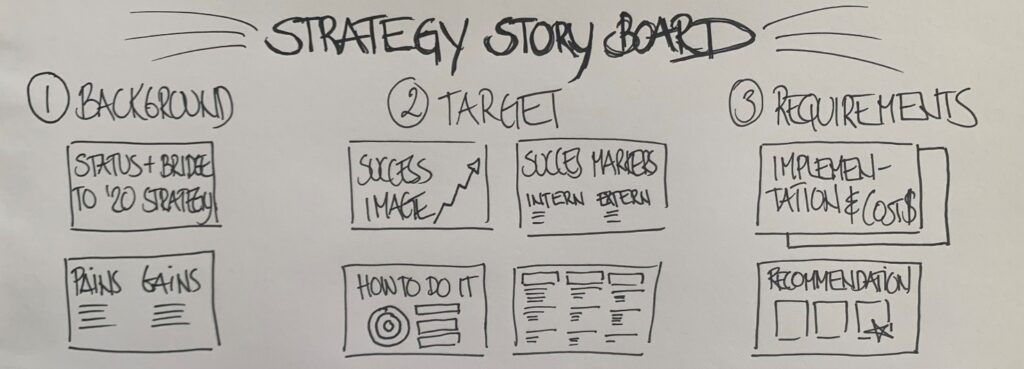
When we have drawn up this outline of what we will produce, we start…
Facilitation guide: The following exercises can directly or indirectly prepare us for the next steps
- Standing in the future – what does our success look like? (How do we know that we have succeeded?)
- Elevator pitch – nailing it now to ensure we keep our optimism going forward
Mood barometer: When we complete this day everyone feels mostly confused, and a bit disheartened at how we will ever turn all of this into a sharp, concise, and ambitious strategy. So, do not wait too long before moving on to day 2&3.
It has been a few days, but the time passed has not been in vain. Our mind has been absorbing and consolidating our output vision. For in the midst of the chaos of different notes and discussions we actually have a clear target and a rough idea of how what our success looks like.
Day 2 & 3: The ‘I think we might actually be on to something here’-days
So, for these two coherent days we start shaping and filling in the empty placeholder slides on our story board.
Facilitation guide:
- SWOT – taking a look at our Strength, Weaknesses, Opportunities and Threats is a good way to pick up from day 1 and add structured input.
- SMART goals – identify how do we know we have succeeded? (Both internal and external markers).
- Focus Areas – differentiate the operational level, the ‘WHAT of what we are doing’. Be careful not to have too many. 4-5 should do.
- Tactical efforts – start structuring sub bullets to the focus areas – this is the ‘HOW of what we are doing
- Consider if you need ‘Enablers’ ‘Guiding Principles’ or other Core Values that might be a useful other level of the HOW we want to achieve the goals across the focus areas.
Mood barometer: The energy is high. We start to see pieces coming together and structure building up. However, the feeling of ‘how will we ever get there’ is also creeping in as we are almost halfway in. And fair enough. We will never finish in plenary. We need to divide and concur from now on. And we need to start producing the final product.
Day 4: The completely necessary ‘recap and reflect’-day not placed at the end of the process
Today we start turning the different sections into an actual strategy document. The Co-creation feature in SharePoint is highly appreciated at this point. We divide, put on our noise cancellation headphones on and each work on a section for the final document or presentation.
Facilitation guide:
- Peace and quit – with frequent scheduled check points
- Facts and figures validation – this might be an assignment someone have been asked to prepare in-between, but we need to have someone validating our sources, data, benchmarks, etc.
Mood barometer: The mind is focused, and creativity is needed. We each consider the best way of presenting the sections we are shaping. Some are drawing, some are starring into the air, but everywhere the mind is deeply engaged in thinking each part through. A playfulness with words, phrasing and visualisation is key – and if we are stuck, we know that a brief check point is coming up shortly where we can ask for input.
Day 5: The ‘not as boring as it might seem’ numbers-day
Before we have a full day to deep dive into the calculation of whatever effort is required one of us has spend yet another day preparing the Excel sheets with all the input on the operational and tactical areas, formulas, etc. I like using a homebrewed Work Breakdown Structure-ish template with effort estimation of each activity.
Facilitation guide:
- Estimating the time costs – go through each of the activities and estimate when it should be done and how long it will take. Make sure that the document sums up and include some percentage to underestimation (because things ALWAYS take longer) and unforeseen activities (that WILL happen).
- Throughout the processes, changes in structure, wording, activities, etc. will happen, and someone will later transfer these updates to the strategy document.
Mood barometer: We get somewhat annoyed with each other for consistently being either too conservative or too time optimistic. Each activity we want to include is quite easily estimated and we agree on when steps can be implemented. But the sum of the estimation is frustrating. We clearly see that the resourced we have will not be enough and it is tempting to cut a bit back on the time estimates and consultant fees to keep the cost down.
However, we need this exercise to find out if the whole thing is worth it. It is free to imagine how we want to aim, but if we are not willing to put our money where our mouth is, we will never succeed with it. So, the right way to slim down the estimate is to make choices of chunks to eliminate rather than underestimating the entire endeavour.
However, we need this exercise to find out if the whole thing is worth it. It is free to imagine how we want to aim, but if we are not willing to put our money where our mouth is, we will never succeed with it. So, the right way to slim down the estimate is to make choices of chunks to eliminate rather than underestimating the entire endeavour.
Day 6: ‘The devil’s advocate’-day
Since day 5 we have been collecting all outstanding input, finalising slides/document sections, illustrations, proof-reading etc. The document looks done and we take yet another round. We might invite a higher-ranking officer to provide feedback, or we take the devil’s advocate role ourselves. But we look at what we have achieved through the eye of our Board, Executives, Program owner or whomever will sanction the strategy. Is there anything they will need? Is there anything they might question?
Facilitation guide: Consider including some of these elements to your presentation
- Pros & Cons overview – especially if the strategy holds different scenarios to choose from (glance at SWOT, costs, etc)
- Gains & Pains – if we have addressed the pains that we want to address, it is a solid help for decision makers to have a clear overview of which of the pains and which of the pains will be addressed
- Recommendations – though decisions makers might not follow your recommendation (for a multitude of reasons) they do appreciate to know the experts’ recommendation
Mood barometer: We feel proud and a bit astonished that this was possible. And also, a bit nervous to be presenting our strategy. We might second guess ourselves. For whom is to say that the thoughts that we came up with are the right ones. The thing is though – there might have been other roads we could have taken. But this one has been solidly thought through and hence it stands a good chance of succeeding.