Category: Blog

  • What I have learned from a failed change

    What I have learned from a failed change

    “I haven’t failed. I’ve just found 10,000 ways that won’t work”, said Thomas Edison, who made one of our time’s greatest changes. There is so much truth in that quote. But seriously – who has the time and money for 10,000 attempts?

    Nearly a decade ago, I courageously embarked on an adventure of managing the people side of an organisational turnaround. With little preliminary qualifications besides the eagerness that follows ignorance about the complexity of managing a change, I ventured into a journey that ended exactly where we did not want. Here are three take-aways from that educational experience.

    LESSON #1: YOU NEED TOP MANAGEMENT INVOLVEMENT

    Though the transition was demanded by top management, we struggled with lack of executive commitment from the get-go. With little direction about where they would like us to end up. With lack of resource allocation to manage the transition. With lack of willingness to advocate the need of the transition to our organisation. We had to do without. Had I been given those terms today, I would politely decline the task.

    Both my personal experience and Prosci’s (market leader in change management) best practice studies have consistently shown that executive sponsorship is key to success in change and transitions. Not only is it the number one reason for success, the lack thereof is also the number one reason for failure. So, without top management engagement, failure was almost inevitable for us.

    According to Prosci’s research studies, executive sponsors’ have the following ‘job description’ in transitions – to be maintained throughout the project lifecycle – not just at the beginning:

    1. Be active and visible
    2. Build a coalition of sponsorship (amongst key leaders and stakeholders)
    3. Manage resistance
    4. Communicate directly to employees

    LESSON #2: YOU NEED A STRUCTURED APPROACH

    The second thing we did wrong was having an extremely flexible approach to the process. We knew the organisation and the people well and thought it best not to plan too far ahead to accommodate for immediate needs. This was an organisation with outspoken antipathy towards management and all that reeked of leadership. An organisation where the average employee age was 58 with a typical seniority of 30 years. Also, it was an organisation with a history of never laying off people. So basically, people had no incentive to engage in the transition, and they had been there for longer than those who dictated the transition (displaying a ‘this too shall pass’ mentality). Also, they knew that not getting on board would have absolutely no consequences for their job security.

    With this knowledge, we thought it best to create an open and involving process. But in retrospect, it was too open, too unstructured. We didn’t plan more than 3-4 months ahead, which led us to spend far too much time and energy on present challenges with limited progress. We should have had a high-level approach to keep us attentive on progress, and to ensure that our focus and process were adapted to the specific phases. Years later, when I attended Prosci’s change management certification programme, I sighed of relief as I was presented to ‘a recipe for change management’ that provided the kind of structure we did not know we needed.

    LESSON #3: YOU NEED TO CAREFULLY PLAN RESISTANCE MANAGEMENT

    The way I have described the organisation’s employees should make any Change Manager foresee a lot of resistance. And there was! We took extraordinary measures to accommodate for that resistance. With the mantra ‘the train is leaving the station – get on board’, we wanted employees to understand that this thing was happening. We invited for countless debates, listened to concerns, accommodated for feedback, involved them and co-created our a… off. We used every tactic available.

    In retrospect, the massive energy spent on the resistance took away a lot of constructive energy from moving ahead. This was frustrating for those who had actually boarded the train and waited impatiently for the train to speed up.

    What I know now is that we don’t have to get everybody on the train before leaving the platform. The change process is an individual process and people will always adopt at different paces. We should have spent less time getting the ‘late bloomers’ onboard. But as these employees often have the loudest voices, we fell into the trap of giving them far too much attention. We should have focused on the majority who could swing either way. It is not that we did not do it – we just did it far too late.

    Having a much deeper understanding of the nature of resistance, makes it quite clear that it is a nuanced field. The way to approach it differs, depending on the individual drivers behind it. And the energy of dealing with it, should be more about planning the right tactics than using all tactics.

    This transition turned out to be my entry into the field of change management. And like Thomas Edison, who eventually got it right with the light bulb, I have used the learnings in practically every change process I have been involved in since. And thankfully, it did not take 10,000 attempts.

  • Most changes fail! Make yours stick

    Most changes fail! Make yours stick

    By using the right incentives to motivate and reinforce change, you increase the chance of successfully changing an organisation. But what the right incentives are depends on understanding cultural preferences.

    It is one month after ’golive’ of a new system in your organisation. The change managers have been dismissed and you’ve celebrated a ve celebrated the as a noun. context right upfront. could be country/international culture or organisational culture (e.g. successful change implementation. Though everyone has received the proper training and heard the key messages the appropriate number of times, system reports reveal an unacceptable number of workarounds. New projects are already in the preliminary phases and the focus is shifting. Still, you acknowledge that reinforcement efforts must be taken up a notch to ensure that the system and processes are being utilised in a way that realise all the benefits promised. But how is reinforcement most effective?

    Changing human behaviour requires a specific process. Understanding of what is changing and why. Desire to change. Knowledge of what to do (differently) and the opportunity to practice. And last but not least, sticking to the new routines. This method for managing change is called ADKAR and was develop by Jeffrey M. Hiatti.

    Incentives should be adapted to cultural preferences

    Two of the five ADKAR steps posit incentives to change. To achieve desire for the change, the incentive to change must be desirable. However, incentives are even more openly used when the changed behaviours are to be reinforced to make the change stick.  

    Reinforcement of change is essentially socialisation as we know it from the academic field of Sociology. Socialisation can be rewarding and appreciative or punishing. Both mechanisms send a clear signal of the desired behaviour. In practice, both can be used by a direct approach of reward or punishment or it can be used indirectly as a dismissal of the unwanted behaviour.

    Finally, socialisation can also be either explicit with blatant praise or reprimand or it can be implicit such as by entrusting more responsibility to someone displaying the desired behaviour or disregarding another who shows unwanted behaviour.

    Just as you are probably not likely to serve prime steak to a vegetarian coming over for dinner, it is equally essential to pay attention to how the incentives you provide matches the cultural context. Especially if you are ensuring change in a culturally diverse setting or are managing a change in a culture different from your own. But how can you identify what is desirable for individuals from unknown cultural mindsets?

    Geert Hofstede (1928) developed a method of making the highly confusing area of cultural challenges manageable by placing cultures on scales of different cultural dimensions. He identified five relevant dimensions such as high/low power distance and masculine/feminine cultures. All national or industrial cultures can then be ranked and placed on scales. The approach is disputed for numerous reasons. For one it is a static reflection of cultures reduced simply to national or industrial traits. However, used reflectively some of the dimensions are helpful when navigating for ways to ensure the right cultural fit with incentive structures.

    In a recent best practice study by Prosci, Change Management challenges were mapped against cultural dimensions. When looking at incentives for reinforcing a change, two dimensions are highly relevant.

    Completely opposite incentives motivate individual vs. collective cultures

    One dimension divides cultures on a scale from highly individual to highly collective. In individual cultures, people are independently expected to take initiative, strive for goals, and ensure their own happiness. At the other end of the scale, in collective cultures, people are expected to act in alignment to the interests of the community or group. In return, the individual expects that their personal interests are always being looked after by the group.

    By keeping this knowledge in mind when planning drivers for changing peoples’ behaviour, it seems logical that acknowledgement of good behaviour in an individual culture is motivational when the rewards focus on the individual. For example, it would be fully acceptable to bring out one person’s extraordinary results as an example to be followed. However, doing the same in a collective culture would be a massive mistake.  It would have an opposite effect, as people would feel uncomfortable with individual acknowledgement. In that type of setting, what would be motivating would be to reward or acknowledge the entire team or group for an effort.

    In between these poles lies a vast range of cultures with traits leaning towards one of the dimensions but without clear affiliation. A safe way to ensure drivers for cultures in this grey area would be to portray the message that “together we are one company and together we must make the change to succeed”.

    Performance orientation drives people towards different goals

    A more direct dimension for ensuring motivation to changes is performance orientation. This is how to encourage or reward performance and give honours. In cultures with low performance orientation, the focus is primarily on social relations. Formal feedback and acknowledgement would be perceived as judgemental and uncomfortable for the individual. It would be far more beneficial to allow the employees to choose their own drivers or rewards – and they might not even be business related. Consequently, the incentives can be highly individualised.

    Where performance orientation is high, employees are expected to constantly improve their performance and more direct methods of communication and incentives are far more common. Resistance to change is often about the individual not being able to see their personal gain from spending energy on changing their habits. Remember that this is energy that could otherwise be used on achieving personal goals. In settings as this, it is imperative to tie together personal performance goals and adaptation to a change. Performance Measurement is a highly motivating factor and can be used directly in a reinforcement plan to ensure commitment to a change.

    Again, there is a grey area between the dimensions. In cultures in-between the poles, change managers often encounter a lack of ownership from the employees. Resistance to measurable performance mechanisms is also common. So, if the cultural setting in which you are managing a change is not overtly a high-performance culture, performance management drivers are a dangerous tool. It is far better in less distinct cultures to provide personal acknowledgement for desired performance or early adoption.

    It is not rocket science to adapt drivers and incentives to the cultural setting. It’s just that doing it without the thought of the cultural setting can lead to counterproductive results. I find that looking at the cultural dimensions provides a simple tool to understanding the scale of cultural traits to consider. To accommodate for risk of reducing culture to simply national aspects, one can look for similar or contradicting preferences on the dimension scale e.g., industrial. If two factors align, it is a good indication of a strong cultural preference. If they misalign, it might mean that we are perhaps moving into the grey area and that at the very least, calls for further enquiry.

  • Mistakes to avoid when managing change in culturally diverse settings

    Mistakes to avoid when managing change in culturally diverse settings

    In a study by Prosci on practices in change management, 84% of respondents rated cultural awareness as being important or very important when managing change.

    However in the globalised business market, it can be argued that national cultures have decreased significance as a factor of importance. If a product or service equals a client’s needs, the interest of overseeing cultural and linguistic differences takes priority. Though that might be the case in some areas of business such as negotiation, it is not the case with change management. The main reason is that change management, is an exercise in appealing to individuals or groups of people. For this we need to consider human factors, such as cultural preferences.

    So, the question is, how do we address cultural diversity to successfully manage change?

    Mistake # 1: Global English is not the cure for cultural deviance

    As internationalisation has become a condition for most organisations, an easy mistake is to assume that interaction between business associates can just be conducted by establishing a common ground by using a common language and implementing global processes. But cultural aspects still distinguish those involved.

    Change Management is essentially about engaging people to put in the effort to learn new practices. The cognitive energy spent in the change process by far exceeds the energy spent on doing something people already know how to do. So, how do we get people to put in the extra effort change requires in their already busy workday?

    We do this by building awareness about the change, creating the desire to change and ensuring that they achieve the abilities to manage the change. The essence of these disciplines is to relate the change to individuals or groups. As cultural aspects are deeply rooted in individuals, we need to be able to manage these within a change process.

    Mistake #2: Reducing culture to stereotypes is ignorant

    If the first mistake is to neglect the influence of culture, the second is to reproduce cultural stereotypes by thinking of culture as merely a national phenomenon. Regrettably, the complexity is far greater.

    Having cultural intelligence (CQ) is not having a world map of stereotypes. Nor is it collecting tales of business contracts failing due to cultural ignorance. Cultural intelligence equals cultural awareness. It is the knowledge and curiosity about cultural variances and parallels. It requires having your antennas out and picking up on sometimes subtle signals. And it is the knowledge of how to incorporate all the relevant considerations into a change management strategy or communication plan that will produce the desired engagement of the people impacted.

    Culture is both a combination of individual, national behaviours and organisational, sub-cultural or industrial preferences. Actually, it can be argued to be much more than this. But in a gallant pursuit of streamlining the complexity, these elements should be considered in the making of successful change management communications.

    6 elements to consider when implementing change in an intercultural setting

    1. Conduct a cultural analysis – when assessing the impact of a change, consider the cultural aspects of the target groups. E.g. Production workers will have different characteristics in the US than in France.
    2. Diagnose yourself – awareness of cultural preferences of others requires you to be acutely aware of your own heritage. As the producer of change management strategy and communication materials, your cultural preferences play as big a part as your know-hows of past success.
    3. Don’t overdo it – the scale of the change determines the need for addressing the cultural complexity. As a rule of thumb, if the change is radical OR if it impacts the employees on a personal level, such as Job role or change in reward structure, cultural factors should be reflected.
    4. Find the landmines – cultural awareness means being sensitive to specific taboos or cultural-specific rules to avoid antipathy. Remember that even the use of change managers is not equally common in all cultures either.
    5. Look for misalignment – you might find alignments between national and organisational, sub-cultural or industrial preferences in regards to specific cultural dimensions such as e.g. power distribution. BUT be sure to look for misalignment as well. These might indicate a reduced impact of the cultural trait and help you avoid falling into a stereotype trap.
    6. One size doesn’t fit all – though it is easier to manage one global strategy, local adjustments can be what make or break how it is interpreted locally. The culturally aware change manager identifies the need for local customizations and join forces with local allies to provide customizations.

  • 4 (selv)erkendelser om danskere, som vil lette dit internationale samarbejde

    4 (selv)erkendelser om danskere, som vil lette dit internationale samarbejde

    Hvis du er en af de 5% af danskerne, som ifølge undervisningsministeriet har høje kulturelle kompetencer, finder du nok ikke noget overraskende her. Men er du i risiko for at være blandt de 66% med lave kulturelle kompetencer (eller blandt de gennemsnitlige 29%), bør du nok læse med.

    Der er en god grund til at kompetencerne ikke er bedre. Historisk set har danskerne i større udstrækning end andre folkefærd, været uvant med at opleve mennesker, som ikke tænker som os selv. Så vi har ikke haft muligheden for at opøve de kompetencer, som 58% af store og mellemstore virksomheder mener er den største eller næststørste udfordring i dag. Nemlig, at kunne forstå og håndtere kulturforskelle. Det er uheldigt at danskerne er dårlige til noget, som mange virksomheder mener er så vigtigt. Den historiske mangel på eksponering af andre mindset har to grundlæggende konsekvenser:

    For det er netop i mødet med andre, at vi bliver bevidste om os selv. Og interkulturelle kompetencer handler ikke kun om at kende til ’de andre’, som vi laver forretninger med. Det handler i høj grad om at være bevidste om vores egen adfærd i mødet med andre.
    I danskernes tilfælde er selvindsigt særligt uundværlig. Vi er nemlig anderledes – på stort set alle områder. Derfor får du her fire indsigter i dansk adfærd, som vi bør vide om os selv, for bedre at kunne begå os på et internationalt marked.

    #1 Autoriteter, beslutninger og ordrer må udfordres

    Vi skoles fra en tidlig alder til at stille spørgsmål, udfordre, debattere og tage stilling. Vi værdsætter dyderne ’demokrati’ og ’ytringsfrihed’ højt. Så det er ikke underligt, at vi er gode til at tage stilling og tale frit. Kombineret med en meget lav magtdistance, hvor alle helst skal være lige, er der ikke deciderede områder, hvor vi ikke føler os berettiget til at udfordre eller stille spørgsmål.

    Udefra virker det besynderligt [læs trættende], at man som chef ikke kan give en dansker en ordre uden at blive stillet et hav af spørgsmål eller opfordret til dialog om opgaven. Bevares, vi udfører jo gerne opgaven. Vi skal bare lige forstå, hvorfor vi skal gøre det. For os er det nemlig ikke udtryk for ulydighed, hvis vi tager initiativ og ’tænker med’. Ledelse i Danmark handler langt hen ad vejen om at udvikle medarbejderne til selv at tage initiativ og træffe gode beslutninger. Sådan er det bare ikke nødvendigvis i andre kulturer. Derfor kan bevidsthed om vores naturlige fremtræden hjælpe os til at nedtone vores udfordrende adfærd.

    Den lave magtdistance i Danmark betyder bl.a. at vi udviser respekt ved at være i øjenhøjde. Vi tillægger generelt titler, høflighedsfraser og påklædning meget lille betydning. Det er fordi, vi bliver målt på vores resultater mere end vores position og fremtræden. ’Det er vel kun godt’ tænker danskere. Men udefra, må vi erkende, at vi virker respektløse, fremstår lidt sjuskede og i andres optik vil opnå større respekt, hvis vi udviser en mere formel adfærd, end vi ville gøre overfor vores danske chef.

    Høflighedsfraser er ikke så nødvendige i Danmark, hvor vi alle har et halvfamiliært forhold til hinanden. Danskerne er blandt de mest tillidsfulde i verden. Andre kan derfor nemt opleve os lidt naive, fordi den grad af tillid vi umiddelbart udviser, er mere ekstrem end alle andres.

    #2 Tillid er noget vi mister, når deadlinen skrider

    Det er ikke kun graden af tillid, som adskiller kulturer, men også, hvad der opbygger tillid. Hvor vi i Danmark får tillid gennem overholdte aftaler, er det andre parametre, som fører til tillid i andre kulturer. I Tyskland er fakta og information tillidsopbyggende, mens det i Japan er relationer. I USA er det præstationer, i Frankrig ærlighed og i Saudi Arabien autoritet.

    Det som opbygger tillid, kan naturligvis også nedbryde den. Vi bør først og fremmest erkende, at stort set alle andre har brug for at opbygge en tillid, som vi typisk tager for givet. Dernæst bør vi også være opmærksomme på, at der er andre måder at opbygge (og miste) tillid på end ved at overholde (eller misse) en deadline. Tillid er vigtig i alle kulturer og danskere skal generelt gøre aktive tiltag for at opbygge andres tillid til os – også selvom vi som udgangspunkt har tillid til dem.

    #3 En god nabo er en usynlig nabo

    Den høje grad af tillid betyder, at vi er mindre afhængige af relationer end de eksempelvis er i Asien. Danskere nærer en dyb respekt for privatlivet. Her er en god nabo en nabo, som ikke blander sig. Og når udenlandske kolleger kommer til Danmark, er det svært at forstå, at vores gode relation brat stopper klokken 16. Dér tømmes arbejdspladserne og ingen bliver inviteret med hjem. For det danske hjem er privat. Fokus på relationer er nemlig noget af det, som nedprioriteres i et land, hvor vi er grundlæggende individualistiske.

    Og selvom vi holder af kollektive beslutninger i Danmark, er vores adfærd individualistisk. Vi beder ikke om personlige tjenester fra folk, som ikke er meget tæt på os. Og det kan virke decideret ubehageligt på os, når vores ’eksotiske’ kolleger vil ses udenfor arbejdstid eller finder på at spørge om en personlig tjeneste. Men det er bare ikke dem, som er underlige. Sådan gør de fleste andre mennesker. Så det bedste råd vi kan tage med fra denne erkendelse, er at beherske vores utilpashed, når andre overskrider en grænse, som for os føles naturlig. Også her er vi nemlig de underlige.

    Hvis du ikke er enig i erkendelse nummer 3, så tænk lige over, hvor mange nye venskaber du har knyttet siden du blev 25 år (+/-).

    #4 Hvis bare jeres uddannelsessystem/sundhedsvæsen/barselsregler/smør var som vores

    På hjemmesiden ’you know you are Danish when…’ er et af svarene: ”… du ved at alle andre flag er irrelevante, fordi dit er ældst’. Udsagnet ironiserer en dansk selvtilfredshed, som andre oplever som et typisk [læs irriterende] dansk karaktertræk. Og ofte tror vi faktisk, at andre ville ønske, at de var som os.

    Vi har ligefrem et ord som ’udansk’, der betyder, at noget er fremmed eller sært. Og det bruges i forståelsen at noget ikke er helt godt. Der er jo intet i vejen med lidt national stolthed, men hvis vi går rundt og tror, at andre er bedre stillet, hvis de bare gør som os, kommer vi til at fremstå mere arrogante end vi formegentligt er interesserede i.

    Når det er sagt, er det jo nærmest uforståeligt, at andre kommer igennem hverdagen med deres inferiøre alternativer til lakrids, rugbrød og dansk smør. Men måske skal vi være opmærksomme på, hvor ofte vi fremhæver vores danske succeser overfor andre.

    Det er næsten ligegyldigt, hvilke kulturelle præferencer man måler på, så ligger danskerne konstant i de ekstreme ender af spektret. Vi er konsekvent de mest … eller de mindst… Det betyder, at på stort set alle parametre, kan vi med en vis sikkerhed gå ud fra at alle andre er mere … eller mindre … end vi selv er. Så det er særlig vigtigt for danskere at tage en selvbevidsthed med ud i verden, når vi indgår i internationale samarbejder. Vi er de mærkelige! Og vores ’normal’ er ikke normalt.

  • 4 cultural traits that explain Danish people’s odd behaviour

    4 cultural traits that explain Danish people’s odd behaviour

    If you do business with Danes, you will encounter cultural traits that are quite peculiar to basically everybody else. The Danes themselves are not likely to be conscious about these traits as cultural awareness in Denmark is generally low. In fact, only 5% of Danes have high cultural competencies, while 66% and 29% have low and average cultural competencies respectively.

    1. Danes have limited knowledge of other cultures.
    2. Danes have limited awareness of how their behaviour is perceived by others.

    It is when we engage with others, that we become conscious of our own features. Non-Danes might therefore experience positive results by being explicit about the way you are and how you work when you interact with Danes. This approach can bring potential differences out in the open. For there will be differences. What is interesting is that the Danish features are consistently at the extreme end of almost any cultural dimension we can measure. And therefore, I give you four insights about Danish behaviour that might help you interpret their odd behaviour and underlying intentions.

    #1 Authorities, decisions and orders will be challenged

    The Danes are schooled from an early age to ask questions, challenge ideas and debate positions. As virtues such as ’Democracy’ and ’Freedom of speech’ are highly valued in Denmark, it is no mystery that the Danes are competent in making up their own mind and speaking freely. But when combined with an extremely low power distance, there are not really areas in life where they won’t feel entitled to share their opinions.

    It can be wearisome if you as a manager must always answer loads of questions and explain decisions when giving a Dane an order. Just be aware, that their behaviour is not an expression of insubordination. Management in Denmark is, to a large extent, about developing your employees to take initiative and make good decisions. So, when the Danes do passively receive orders, it doesn’t mean that they won’t execute it. They just need to understand the assignment, to better assist with deciding on the best way to do it. If you are an employee with a Danish manager, it will be expected that you engage in the assignment by asking questions and filling in the gaps in instructions yourself.

    The extremely low power distance in Denmark means that organisations are structured with flat hierarchies. Egalitarianism is precious to the Danes and therefore respect is shown by being at eye level. Remember that eye contact is considered an important signal of this – no matter how high or low the person you engage with rank.

    The flat structure also means that very little importance is placed on titles, courtesy phrases, and clothing. This is because people are being measured on their achievements far more than on their position and appearance. What you might interpret as a lack of respect is not an attempt to be disrespectful. The Danish parameters for respect simply differs from most other cultures. Often, they are not conscious about how they appear to outsiders or are unwilling to adapt.

    #2 Danish trust will surprise you

    A reason that courtesy phrases are not widely used in Denmark is that Danes all have a semi-familiar bond to each other. The Danes are amongst the most trusting people in the world. Though you will experience their immediate confidence in you, this should not be confused with naivety. In Denmark, strangers are usually not that distant from one another as they all know each other in some way, have mutual acquaintances, or went to the same school or kindergarten.

    It is not only the degree of trust that separates cultures. What builds it varies. In Germany, facts and information inspire confidence, while in Japan it is relations. In the U.S. it is performance, in France, it is honesty and in Saudi Arabia it is authority. In Denmark, confidence is built by honouring agreements.

    What builds trust can also break it. When dealing with Danes you should therefore pay attention to agreements and keep to deadlines. Generally, punctuality is important to the Danes and you ought to know that in Denmark people arrive on time. For social occasions, it is acceptable to be up to ten minutes late, but no later than that (and don’t ever arrive early!). 

    #3 You can be the best of colleagues, But you are not necessarily friends

    The high degree of trust causes Danes to be less dependent on relations than you would experience in, for example, Asia. The Danes nourish a profound respect for personal life. In Denmark, a good neighbour is a neighbour that keeps to himself. You will experience that the great relationship you have with your Danish colleague ends at 4 p.m. By then, workplaces are emptied, and people go home. Social arrangements are not highly valued and especially not if spontaneous. So, if you are hoping for an invitation to a private dinner at your Danish colleague’s house, you will likely be waiting for a while as the Danish home is a very private place.

    Focus on personal relations are de-emphasised in a country where people are fundamentally individualistic. Though the Danes love collective decisions, their behaviour is individualistic. An implication of this is that unless you are close personal friends, asking a Dane for a personal favour is a very transgressive behaviour and they will likely react with more hesitancy than you expect.

    #4 They honestly think that their Educational system/Health system/Parental leave/butter is the eighth wonder of the world

    On the website ’you know you are Danish when…’ one of the answers is: ”… You know that all the flags in the world are irrelevant, because yours was first’. The statement is an ironic remark about the unique Danish smugness that you will undoubtedly meet regarding numerous Danish products or social structures. Danes genuinely believe that all other people wish to have what they have.

    To be ’un-Danish’ (an actual word in the Danish vocabulary) is used when ideas or behaviour are not quite good. You can’t really do anything about this character trait but knowing about it might lead you to simply smile as they bluntly promote everything Danish as the best thing in the world. However, be aware that though Danes like to talk about the superiority of seemingly endless amount if Danish wonders, they hold a deep dislike for bragging in general. There is a codex (’Janteloven’) that makes all forms of bragging or self-promotion distasteful to the Danes. So, though they might be smug about anything Danish, but they will not brag about personal achievements. And they do not appreciate others’ self-promotion either.

    No matter which cultural preference you choose, the Danes are likely to be found in the extreme end of the scale. This means that Danes are consistently the most… or the least… This also means that regardless of there you are from, they will be more extreme than what you have encountered before.

  • How to do a strategy in 5 days

    How to do a strategy in 5 days

    Another year, another strategy. Q1 is often the time for setting the direction for where to go and what to achieve. So, we need at strategy. That master plan we can use to guide our ongoing decisions. That aim we can break down to manageable ‘to do’ lists. That roadmap to get the organisation treading in the same direction.

    I LOVE strategies. Love organising the chaotic complexity of our goals, our project, our purpose, or our challenges in a neat overview. However, I am not alone in my love for strategies:

    • Leadership loves them because they can align on the business priorities
    • Management loves them as a direction to navigate by
    • Employees love to know and understand what the focus is
    • And management consultants love how many potential workshops can be put into a strategy process

    Though preparing a strategy varies a lot depending on the level of the strategy and the amount of analysis required, it does not necessarily need to be months in the making. Two years ago, I was advising a client on a strategy development which was completed in just 6 non-consecutive days (In all fairness, not including the many hours of background analysis, student helper proofreading etc.).
    Do you want to know how we did it?

    Day 1: The ‘how the f… will we ever get there’-day

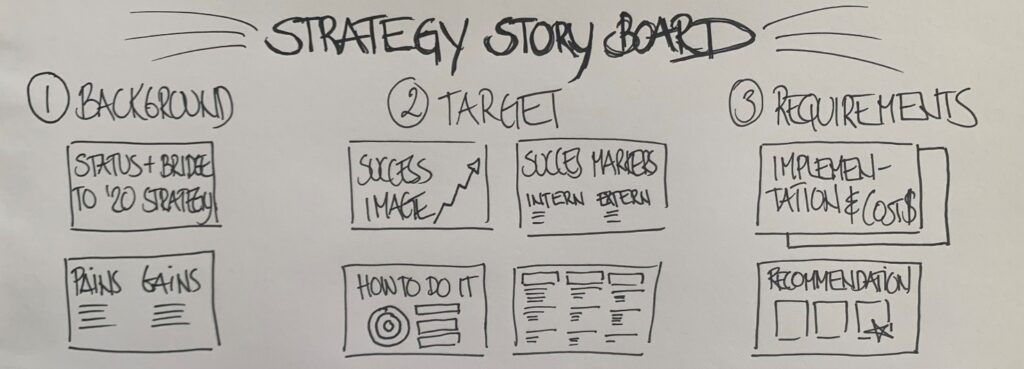
    Few things are as frightening as a blank canvas! So, a way to break away from this paralysing state, we want to start visualising the outcome. Are we in need of three qualified scenarios for the executives to choose from? Are we preparing a 3-year strategy that we then break down year by year, are we strategizing how to realise our project objectives or identifying our must-win battles? Regardless, we need a clear vision of our output first.

    So, we draw up a story board. A table of content if you want. But high level on what we would like our final product to include. It might be as simple as three chapters: 1) Background (e.g., bridge to prior strategy, rationale, analysis) 2) Target (e.g., the ambition of the strategy, how we want to achieve it) and 3) Requirements and Recommendations (e.g., implementation scenarios, WBS/Work-Breakdown-structure, Cost estimate).

    When we have drawn up this outline of what we will produce, we start…

    Facilitation guide: The following exercises can directly or indirectly prepare us for the next steps

    • Standing in the future – what does our success look like? (How do we know that we have succeeded?)
    • Elevator pitch – nailing it now to ensure we keep our optimism going forward

    Mood barometer: When we complete this day everyone feels mostly confused, and a bit disheartened at how we will ever turn all of this into a sharp, concise, and ambitious strategy. So, do not wait too long before moving on to day 2&3.

    It has been a few days, but the time passed has not been in vain. Our mind has been absorbing and consolidating our output vision. For in the midst of the chaos of different notes and discussions we actually have a clear target and a rough idea of how what our success looks like.

    Day 2 & 3: The ‘I think we might actually be on to something here’-days

    So, for these two coherent days we start shaping and filling in the empty placeholder slides on our story board.

    Facilitation guide:

    • SWOT – taking a look at our Strength, Weaknesses, Opportunities and Threats is a good way to pick up from day 1 and add structured input.
    • SMART goals – identify how do we know we have succeeded? (Both internal and external markers).
    • Focus Areas – differentiate the operational level, the ‘WHAT of what we are doing’. Be careful not to have too many. 4-5 should do.
    • Tactical efforts – start structuring sub bullets to the focus areas – this is the ‘HOW of what we are doing
    • Consider if you need ‘Enablers’ ‘Guiding Principles’ or other Core Values that might be a useful other level of the HOW we want to achieve the goals across the focus areas.

    Mood barometer: The energy is high. We start to see pieces coming together and structure building up. However, the feeling of ‘how will we ever get there’ is also creeping in as we are almost halfway in. And fair enough. We will never finish in plenary. We need to divide and concur from now on. And we need to start producing the final product.

    Day 4: The completely necessary ‘recap and reflect’-day not placed at the end of the process

    Today we start turning the different sections into an actual strategy document. The Co-creation feature in SharePoint is highly appreciated at this point. We divide, put on our noise cancellation headphones on and each work on a section for the final document or presentation.

    Facilitation guide:

    • Peace and quit – with frequent scheduled check points
    • Facts and figures validation – this might be an assignment someone have been asked to prepare in-between, but we need to have someone validating our sources, data, benchmarks, etc.

    Mood barometer: The mind is focused, and creativity is needed. We each consider the best way of presenting the sections we are shaping. Some are drawing, some are starring into the air, but everywhere the mind is deeply engaged in thinking each part through. A playfulness with words, phrasing and visualisation is key – and if we are stuck, we know that a brief check point is coming up shortly where we can ask for input.

    Day 5: The ‘not as boring as it might seem’ numbers-day

    Before we have a full day to deep dive into the calculation of whatever effort is required one of us has spend yet another day preparing the Excel sheets with all the input on the operational and tactical areas, formulas, etc. I like using a homebrewed Work Breakdown Structure-ish template with effort estimation of each activity.

    Facilitation guide:

    • Estimating the time costs – go through each of the activities and estimate when it should be done and how long it will take. Make sure that the document sums up and include some percentage to underestimation (because things ALWAYS take longer) and unforeseen activities (that WILL happen).
    • Throughout the processes, changes in structure, wording, activities, etc. will happen, and someone will later transfer these updates to the strategy document.

    Mood barometer: We get somewhat annoyed with each other for consistently being either too conservative or too time optimistic. Each activity we want to include is quite easily estimated and we agree on when steps can be implemented. But the sum of the estimation is frustrating. We clearly see that the resourced we have will not be enough and it is tempting to cut a bit back on the time estimates and consultant fees to keep the cost down.

    However, we need this exercise to find out if the whole thing is worth it. It is free to imagine how we want to aim, but if we are not willing to put our money where our mouth is, we will never succeed with it. So, the right way to slim down the estimate is to make choices of chunks to eliminate rather than underestimating the entire endeavour.

    However, we need this exercise to find out if the whole thing is worth it. It is free to imagine how we want to aim, but if we are not willing to put our money where our mouth is, we will never succeed with it. So, the right way to slim down the estimate is to make choices of chunks to eliminate rather than underestimating the entire endeavour.

    Day 6: ‘The devil’s advocate’-day

    Since day 5 we have been collecting all outstanding input, finalising slides/document sections, illustrations, proof-reading etc. The document looks done and we take yet another round. We might invite a higher-ranking officer to provide feedback, or we take the devil’s advocate role ourselves. But we look at what we have achieved through the eye of our Board, Executives, Program owner or whomever will sanction the strategy. Is there anything they will need? Is there anything they might question?

    Facilitation guide: Consider including some of these elements to your presentation

    • Pros & Cons overview – especially if the strategy holds different scenarios to choose from (glance at SWOT, costs, etc)
    • Gains & Pains – if we have addressed the pains that we want to address, it is a solid help for decision makers to have a clear overview of which of the pains and which of the pains will be addressed
    • Recommendations – though decisions makers might not follow your recommendation (for a multitude of reasons) they do appreciate to know the experts’ recommendation

    Mood barometer: We feel proud and a bit astonished that this was possible. And also, a bit nervous to be presenting our strategy. We might second guess ourselves. For whom is to say that the thoughts that we came up with are the right ones. The thing is though – there might have been other roads we could have taken. But this one has been solidly thought through and hence it stands a good chance of succeeding.

  • Du har altså ikke for travlt til en kernefortælling!

    Du har altså ikke for travlt til en kernefortælling!

    Kernefortællingen er en beskeden størrelse. Dens største last er, at den bliver ofte overses eller nedprioriteres i en travl hverdag. Det er en brandærgeligt. Der er nemlig stor forretningsmæssig værdi i at have styr på sine budskaber. Og nogle gange skal man tage sig tid til at stoppe op og gøre det ordenligt.

    En mellemstor global ingeniørvirksomhed brugte to dage på et strategiseminar for topledelsen. Seminaret gik godt og den administrerende direktør var tilfreds. I dagene efter skulle lederne fortælle deres respektive afdelinger om de nye retningslinjer. Den administrerende direktør deltog ved alle møderne rundt om i virksomheden. Det, der gjorde det største indtryk på ham var, hvor forskelligt strategien blev genfortalt af de ledere, som blot dagen inden, havde været enige om den.

    En virksomheds strategi eller profil skal være skarp. Og den skal formidles skarpt. Til det er en kernefortælling et godt redskab, som giver værdi, uanset om den laves for en hele virksomheden eller for et konkret projekt.

    Investeringen værd

    Okay faktisk kan investeringen i en kernefortælling estimeres. Udgifterne er primært ressourcerne til opgaven. Og det er ikke nok at sætte den skarpeste pen til at skrive løs.

    Hvis man ikke allerede har en skarp profil, er første fase analyse. Det er både kortlægning af vores kultur, den værdi vi skaber for vores kunder og hvordan vi placerer os i markedet. Det handler ligeledes om vores strategiske visioner og vores værdier. Først når det er skarpt, skal det formidles på en ensrettet måde. Jo mere sammenhængende vi kan fortælle vores historie og jo mere enslydende budskaberne formidles, des stærkere bliver indtrykket, vi efterlader.

    En stærk fortælling bliver husket. Og den bliver genfortalt, som vi ønsker, at den skal genfortælles. Så den primære værdi af en kernefortælling, er den kontrol, vi får over vores egne budskaber.

    Kernefortællingen er en tekst på 1-2 sider. Den er ultra skarp på enkelte hovedbudskaber og hver eneste formulering er velovervejet. Udenfor redaktionsgruppen vil få nogensinde læse kernefortællingen i sin primære form. Den bruges i andre formater, sammenklipninger eller delelementer alt efter formålet. Den tid det koster, at få lavet kernefortællingen er hurtigt tjent hjem i eksekveringstimer. Med den i hånden skal vi nemlig ikke starte forfra, hver eneste gang vi skal skrive tekst til hjemmesiden, nyhedsbrevet, tilbuddet, præsentationen, stillingsopslaget, medarbejderintroduktionsforløbet eller strategien.

    Ser man kernefortællingers anvendelsesværdi i praksis, undres man over, at den så ofte overses. For det gør den. Helt overordnet kan man sige, at jo flere mennesker, der skal formidle budskaberne om virksomheden eller projektet, des vigtigere bliver kernefortællingen.

    Har du tid til et par gode råd?

    Når vi har indset, at vi skal have en kernefortælling, kommer her et par gode råd til dét vi skal gøre mere af og dét vi skal gøre mindre af:

     #1: Det absolut vigtigste element er, at de rigtige mennesker bliver involveret i skriveprocessen. Ledelsen skal investeres i processen – også den tekstnære, redaktionelle del af den. De skal ikke bare godkende kernefortællingen. Det er dem, der skal formidle den med troværdighed og overbevisning. Og derfor er det helt – vi gentager – helt afgørende, at involvere dem.

    #2: Og her nærmer vi os en af de klassiske faldgruber. Lad os kalde den ’respekt for ledelsens tid’. Ofte får ledelsen fremlagt færdigtredigerede dokumenter eller beslutningsoplæg, som de skal godkende. Det virker bare ikke med kernefortællingen! De skal ikke bare med for deres bemyndigelses skyld. De skal med for at få den ind under huden. De skal kunne fortælle en enslydende kernefortælling alle vegne og derfor skal de med i skabelsen.

    #3: En anden faldgrube kan vi kalde ’vi er jo enige’ eller ’det ved vi jo godt’. Vi ser ofte, at mange negligerer betydningen af at samle, strukturere og prioritere vores viden om os selv på en måde, som kan formidles i 2-4 hovedbudskaber. Det sker ofte, at vi slutter et strategiseminar, projekt kickoff, eller hvad det ellers kunne være, med en enighed om de store linjer. Men jo skarpere vi bliver på de små ord i de store linjer, des klarere får vi budskaberne igennem.

    #4: Det sidste gode råd er at sikre et bevidst sprogvalg, som afspejler virksomhedens tone. Budskaber går renere ind, når der er overensstemmelse mellem ord og den måde ordene lyder. Tonen betyder også, at modtagerne ikke kun læser men faktisk også hører og mærker afsenderen. Og det efterlader et langt stærkere indtryk på os.

    Så næste gang den administrerende direktør overværer sine ledere genfortælle virksomhedens strategi på en måde, så budskaberne går ensartet igennem på tværs af organisationen, vil han garanteret være tilfreds med, at have investeret den ekstra halve dag på at sikre opsamlingen i en skarp kernefortælling.