Jeg kører elbil. Og jeg elsker det faktisk. Stille. Hurtig. Praktisk. Ingen gearskift. Ingen dårlig samvittighed ved tankstationen. Og på mange måder et ret strålende billede på moderne teknologi: smooth, effektiv og designet til at fjerne friktion og gøre mit arbejde i den lettere.
Men er det min drømmebil? Hvis jeg kunne, holdt der en gammel Land Rover Defender i min indkørsel. Den larmer. Den er upraktisk. Styretøjet føles som en diplomatisk anbefaling mere end en reel mekanisk forbindelse. Og komfortniveauet er cirka som at sidde i en våd værktøjskasse. For slet ikke at tale om dens sorte aftryk på samvittigheden.
Da jeg i morges hang (lydløst) i morgentrafikken, tænkte jeg, at alle de AI-implementeringer, som finder sted rundt omkring minder lidt om dette dilemma. At vi forsøger at installere fremtidens teknologi i et menneskeligt karosseri, som slet ikke er gearet til den hastighed. Lidt som at lodde et batteri i den gamle Defender for at kunne sætte strøm til.
Selvom de fleste medarbejdere fik en eller anden software-update i sidste kvartal – og sikkert også i kvartalet før – er AI en så grundlæggende forandring, at ingen af os reelt har prøvet noget tilsvarende før. Ikke i arbejdslivet. Ikke i den hastighed. Ikke i den skala.
Måske er det teknisk set muligt at elektrificere den gamle Defender. Men spørgsmålet er, hvad skal der til for at det bliver godt?
Som en der leder mennesker og organisationer gennem forandringer, er mit perspektiv naturligvis menneskeligt før teknisk. Ja, AI er ny teknologi. Men menneskelig adfærd er ikke. Vi reagerer stadig på status, identitet, usikkerhed, sociale dynamikker, følelsen af kontrol og frygten for at miste relevans — præcis som vi altid har gjort.
Så når AI-initiativer ikke glider så let som Claude og Chat påstår, det skulle, er det ikke mangel på hverken teknologi eller intentioner. Det handler om, at AI er løsninger designet til logik, som vi skal have til at fungere med mennesker. Og her brister jeg altså lige illusionen om, at mennesket er et logisk væsen.
Det er vi overhoved ikke. Vi er vanedyr. Vi er sociale væsener. Og vi beskytter identitet lang mere end effektivitet. Og det er jo netop derfor, potentialet for samspillet mellem kunstig og menneskelig intelligens er så tillokkende. Så måske er den mere interessante opgave i implementeringen af AI, ikke er at gøre mennesker mere maskinelle, men at gøre teknologien mere menneskelig.
Måske en dag jeg kan køre kun lettere ukomfortabel og med grøn samvittighed i en gammel Defender, som er opdateret til at operere på nyere teknologi og som derfor giver den perfekte balance af identitet, karakter og fornemmelse – præcis de ting, mennesker er bange for at miste i mødet med det kunstige.
“I haven’t failed. I’ve just found 10,000 ways that won’t work”, said Thomas Edison, who made one of our time’s greatest changes. There is so much truth in that quote. But seriously – who has the time and money for 10,000 attempts?
Nearly a decade ago, I courageously embarked on an adventure of managing the people side of an organisational turnaround. With little preliminary qualifications besides the eagerness that follows ignorance about the complexity of managing a change, I ventured into a journey that ended exactly where we did not want. Here are three take-aways from that educational experience.
LESSON #1: YOU NEED TOP MANAGEMENT INVOLVEMENT
Though the transition was demanded by top management, we struggled with lack of executive commitment from the get-go. With little direction about where they would like us to end up. With lack of resource allocation to manage the transition. With lack of willingness to advocate the need of the transition to our organisation. We had to do without. Had I been given those terms today, I would politely decline the task.
Both my personal experience and Prosci’s (market leader in change management) best practice studies have consistently shown that executive sponsorship is key to success in change and transitions. Not only is it the number one reason for success, the lack thereof is also the number one reason for failure. So, without top management engagement, failure was almost inevitable for us.
According to Prosci’s research studies, executive sponsors’ have the following ‘job description’ in transitions – to be maintained throughout the project lifecycle – not just at the beginning:
Be active and visible
Build a coalition of sponsorship (amongst key leaders and stakeholders)
Manage resistance
Communicate directly to employees
LESSON #2: YOU NEED A STRUCTURED APPROACH
The second thing we did wrong was having an extremely flexible approach to the process. We knew the organisation and the people well and thought it best not to plan too far ahead to accommodate for immediate needs. This was an organisation with outspoken antipathy towards management and all that reeked of leadership. An organisation where the average employee age was 58 with a typical seniority of 30 years. Also, it was an organisation with a history of never laying off people. So basically, people had no incentive to engage in the transition, and they had been there for longer than those who dictated the transition (displaying a ‘this too shall pass’ mentality). Also, they knew that not getting on board would have absolutely no consequences for their job security.
With this knowledge, we thought it best to create an open and involving process. But in retrospect, it was too open, too unstructured. We didn’t plan more than 3-4 months ahead, which led us to spend far too much time and energy on present challenges with limited progress. We should have had a high-level approach to keep us attentive on progress, and to ensure that our focus and process were adapted to the specific phases. Years later, when I attended Prosci’s change management certification programme, I sighed of relief as I was presented to ‘a recipe for change management’ that provided the kind of structure we did not know we needed.
LESSON #3: YOU NEED TO CAREFULLY PLAN RESISTANCE MANAGEMENT
The way I have described the organisation’s employees should make any Change Manager foresee a lot of resistance. And there was! We took extraordinary measures to accommodate for that resistance. With the mantra ‘the train is leaving the station – get on board’, we wanted employees to understand that this thing was happening. We invited for countless debates, listened to concerns, accommodated for feedback, involved them and co-created our a… off. We used every tactic available.
In retrospect, the massive energy spent on the resistance took away a lot of constructive energy from moving ahead. This was frustrating for those who had actually boarded the train and waited impatiently for the train to speed up.
What I know now is that we don’t have to get everybody on the train before leaving the platform. The change process is an individual process and people will always adopt at different paces. We should have spent less time getting the ‘late bloomers’ onboard. But as these employees often have the loudest voices, we fell into the trap of giving them far too much attention. We should have focused on the majority who could swing either way. It is not that we did not do it – we just did it far too late.
Having a much deeper understanding of the nature of resistance, makes it quite clear that it is a nuanced field. The way to approach it differs, depending on the individual drivers behind it. And the energy of dealing with it, should be more about planning the right tactics than using all tactics.
This transition turned out to be my entry into the field of change management. And like Thomas Edison, who eventually got it right with the light bulb, I have used the learnings in practically every change process I have been involved in since. And thankfully, it did not take 10,000 attempts.
By using the right incentives to motivate and reinforce change, you increase the chance of successfully changing an organisation. But what the right incentives are depends on understanding cultural preferences.
It is one month after ’golive’ of a new system in your organisation. The change managers have been dismissed and you’ve celebrated a ve celebrated the as a noun. context right upfront. could be country/international culture or organisational culture (e.g. successful change implementation. Though everyone has received the proper training and heard the key messages the appropriate number of times, system reports reveal an unacceptable number of workarounds. New projects are already in the preliminary phases and the focus is shifting. Still, you acknowledge that reinforcement efforts must be taken up a notch to ensure that the system and processes are being utilised in a way that realise all the benefits promised. But how is reinforcement most effective?
Changing human behaviour requires a specific process. Understanding of what is changing and why. Desire to change. Knowledge of what to do (differently) and the opportunity to practice. And last but not least, sticking to the new routines. This method for managing change is called ADKAR and was develop by Jeffrey M. Hiatti.
Incentives should be adapted to cultural preferences
Two of the five ADKAR steps posit incentives to change. To achieve desire for the change, the incentive to change must be desirable. However, incentives are even more openly used when the changed behaviours are to be reinforced to make the change stick.
Reinforcement of change is essentially socialisation as we know it from the academic field of Sociology. Socialisation can be rewarding and appreciative or punishing. Both mechanisms send a clear signal of the desired behaviour. In practice, both can be used by a direct approach of reward or punishment or it can be used indirectly as a dismissal of the unwanted behaviour.
Finally, socialisation can also be either explicit with blatant praise or reprimand or it can be implicit such as by entrusting more responsibility to someone displaying the desired behaviour or disregarding another who shows unwanted behaviour.
Just as you are probably not likely to serve prime steak to a vegetarian coming over for dinner, it is equally essential to pay attention to how the incentives you provide matches the cultural context. Especially if you are ensuring change in a culturally diverse setting or are managing a change in a culture different from your own. But how can you identify what is desirable for individuals from unknown cultural mindsets?
Geert Hofstede (1928) developed a method of making the highly confusing area of cultural challenges manageable by placing cultures on scales of different cultural dimensions. He identified five relevant dimensions such as high/low power distance and masculine/feminine cultures. All national or industrial cultures can then be ranked and placed on scales. The approach is disputed for numerous reasons. For one it is a static reflection of cultures reduced simply to national or industrial traits. However, used reflectively some of the dimensions are helpful when navigating for ways to ensure the right cultural fit with incentive structures.
In a recent best practice study by Prosci, Change Management challenges were mapped against cultural dimensions. When looking at incentives for reinforcing a change, two dimensions are highly relevant.
Completely opposite incentives motivate individual vs. collective cultures
One dimension divides cultures on a scale from highly individual to highly collective. In individual cultures, people are independently expected to take initiative, strive for goals, and ensure their own happiness. At the other end of the scale, in collective cultures, people are expected to act in alignment to the interests of the community or group. In return, the individual expects that their personal interests are always being looked after by the group.
By keeping this knowledge in mind when planning drivers for changing peoples’ behaviour, it seems logical that acknowledgement of good behaviour in an individual culture is motivational when the rewards focus on the individual. For example, it would be fully acceptable to bring out one person’s extraordinary results as an example to be followed. However, doing the same in a collective culture would be a massive mistake. It would have an opposite effect, as people would feel uncomfortable with individual acknowledgement. In that type of setting, what would be motivating would be to reward or acknowledge the entire team or group for an effort.
In between these poles lies a vast range of cultures with traits leaning towards one of the dimensions but without clear affiliation. A safe way to ensure drivers for cultures in this grey area would be to portray the message that “together we are one company and together we must make the change to succeed”.
Performance orientation drives people towards different goals
A more direct dimension for ensuring motivation to changes is performance orientation. This is how to encourage or reward performance and give honours. In cultures with low performance orientation, the focus is primarily on social relations. Formal feedback and acknowledgement would be perceived as judgemental and uncomfortable for the individual. It would be far more beneficial to allow the employees to choose their own drivers or rewards – and they might not even be business related. Consequently, the incentives can be highly individualised.
Where performance orientation is high, employees are expected to constantly improve their performance and more direct methods of communication and incentives are far more common. Resistance to change is often about the individual not being able to see their personal gain from spending energy on changing their habits. Remember that this is energy that could otherwise be used on achieving personal goals. In settings as this, it is imperative to tie together personal performance goals and adaptation to a change. Performance Measurement is a highly motivating factor and can be used directly in a reinforcement plan to ensure commitment to a change.
Again, there is a grey area between the dimensions. In cultures in-between the poles, change managers often encounter a lack of ownership from the employees. Resistance to measurable performance mechanisms is also common. So, if the cultural setting in which you are managing a change is not overtly a high-performance culture, performance management drivers are a dangerous tool. It is far better in less distinct cultures to provide personal acknowledgement for desired performance or early adoption.
It is not rocket science to adapt drivers and incentives to the cultural setting. It’s just that doing it without the thought of the cultural setting can lead to counterproductive results. I find that looking at the cultural dimensions provides a simple tool to understanding the scale of cultural traits to consider. To accommodate for risk of reducing culture to simply national aspects, one can look for similar or contradicting preferences on the dimension scale e.g., industrial. If two factors align, it is a good indication of a strong cultural preference. If they misalign, it might mean that we are perhaps moving into the grey area and that at the very least, calls for further enquiry.
In a study by Prosci on practices in change management, 84% of respondents rated cultural awareness as being important or very important when managing change.
However in the globalised business market, it can be argued that national cultures have decreased significance as a factor of importance. If a product or service equals a client’s needs, the interest of overseeing cultural and linguistic differences takes priority. Though that might be the case in some areas of business such as negotiation, it is not the case with change management. The main reason is that change management, is an exercise in appealing to individuals or groups of people. For this we need to consider human factors, such as cultural preferences.
So, the question is, how do we address cultural diversity to successfully manage change?
Mistake # 1: Global English is not the cure for cultural deviance
As internationalisation has become a condition for most organisations, an easy mistake is to assume that interaction between business associates can just be conducted by establishing a common ground by using a common language and implementing global processes. But cultural aspects still distinguish those involved.
Change Management is essentially about engaging people to put in the effort to learn new practices. The cognitive energy spent in the change process by far exceeds the energy spent on doing something people already know how to do. So, how do we get people to put in the extra effort change requires in their already busy workday?
We do this by building awareness about the change, creating the desire to change and ensuring that they achieve the abilities to manage the change. The essence of these disciplines is to relate the change to individuals or groups. As cultural aspects are deeply rooted in individuals, we need to be able to manage these within a change process.
Mistake #2: Reducing culture to stereotypes is ignorant
If the first mistake is to neglect the influence of culture, the second is to reproduce cultural stereotypes by thinking of culture as merely a national phenomenon. Regrettably, the complexity is far greater.
Having cultural intelligence (CQ) is not having a world map of stereotypes. Nor is it collecting tales of business contracts failing due to cultural ignorance. Cultural intelligence equals cultural awareness. It is the knowledge and curiosity about cultural variances and parallels. It requires having your antennas out and picking up on sometimes subtle signals. And it is the knowledge of how to incorporate all the relevant considerations into a change management strategy or communication plan that will produce the desired engagement of the people impacted.
Culture is both a combination of individual, national behaviours and organisational, sub-cultural or industrial preferences. Actually, it can be argued to be much more than this. But in a gallant pursuit of streamlining the complexity, these elements should be considered in the making of successful change management communications.
6 elements to consider when implementing change in an intercultural setting
Conduct a cultural analysis – when assessing the impact of a change, consider the cultural aspects of the target groups. E.g. Production workers will have different characteristics in the US than in France.
Diagnose yourself – awareness of cultural preferences of others requires you to be acutely aware of your own heritage. As the producer of change management strategy and communication materials, your cultural preferences play as big a part as your know-hows of past success.
Don’t overdo it – the scale of the change determines the need for addressing the cultural complexity. As a rule of thumb, if the change is radical OR if it impacts the employees on a personal level, such as Job role or change in reward structure, cultural factors should be reflected.
Find the landmines – cultural awareness means being sensitive to specific taboos or cultural-specific rules to avoid antipathy. Remember that even the use of change managers is not equally common in all cultures either.
Look for misalignment – you might find alignments between national and organisational, sub-cultural or industrial preferences in regards to specific cultural dimensions such as e.g. power distribution. BUT be sure to look for misalignment as well. These might indicate a reduced impact of the cultural trait and help you avoid falling into a stereotype trap.
One size doesn’t fit all – though it is easier to manage one global strategy, local adjustments can be what make or break how it is interpreted locally. The culturally aware change manager identifies the need for local customizations and join forces with local allies to provide customizations.
Another year, another strategy. Q1 is often the time for setting the direction for where to go and what to achieve. So, we need at strategy. That master plan we can use to guide our ongoing decisions. That aim we can break down to manageable ‘to do’ lists. That roadmap to get the organisation treading in the same direction.
I LOVE strategies. Love organising the chaotic complexity of our goals, our project, our purpose, or our challenges in a neat overview. However, I am not alone in my love for strategies:
Leadership loves them because they can align on the business priorities
Management loves them as a direction to navigate by
Employees love to know and understand what the focus is
And management consultants love how many potential workshops can be put into a strategy process
Though preparing a strategy varies a lot depending on the level of the strategy and the amount of analysis required, it does not necessarily need to be months in the making. Two years ago, I was advising a client on a strategy development which was completed in just 6 non-consecutive days (In all fairness, not including the many hours of background analysis, student helper proofreading etc.). Do you want to know how we did it?
Day 1: The ‘how the f… will we ever get there’-day
Few things are as frightening as a blank canvas! So, a way to break away from this paralysing state, we want to start visualising the outcome. Are we in need of three qualified scenarios for the executives to choose from? Are we preparing a 3-year strategy that we then break down year by year, are we strategizing how to realise our project objectives or identifying our must-win battles? Regardless, we need a clear vision of our output first.
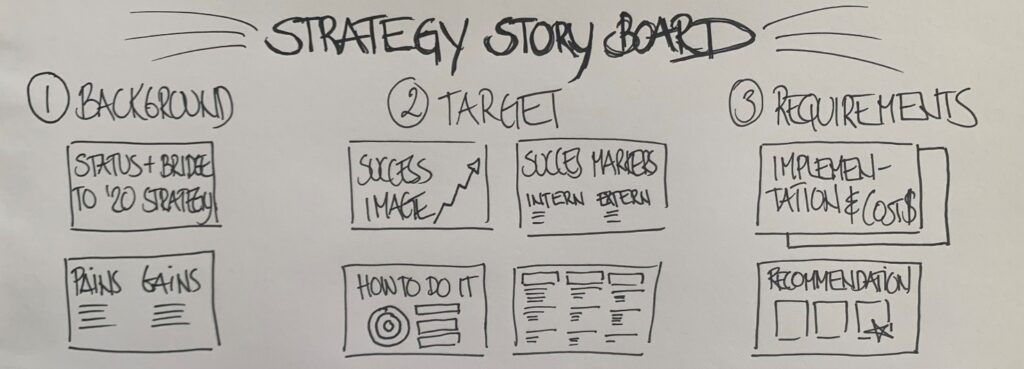
So, we draw up a story board. A table of content if you want. But high level on what we would like our final product to include. It might be as simple as three chapters: 1) Background (e.g., bridge to prior strategy, rationale, analysis) 2) Target (e.g., the ambition of the strategy, how we want to achieve it) and 3) Requirements and Recommendations (e.g., implementation scenarios, WBS/Work-Breakdown-structure, Cost estimate).
When we have drawn up this outline of what we will produce, we start…
Facilitation guide: The following exercises can directly or indirectly prepare us for the next steps
Standing in the future – what does our success look like? (How do we know that we have succeeded?)
Elevator pitch – nailing it now to ensure we keep our optimism going forward
Mood barometer: When we complete this day everyone feels mostly confused, and a bit disheartened at how we will ever turn all of this into a sharp, concise, and ambitious strategy. So, do not wait too long before moving on to day 2&3.
It has been a few days, but the time passed has not been in vain. Our mind has been absorbing and consolidating our output vision. For in the midst of the chaos of different notes and discussions we actually have a clear target and a rough idea of how what our success looks like.
Day 2 & 3: The ‘I think we might actually be on to something here’-days
So, for these two coherent days we start shaping and filling in the empty placeholder slides on our story board.
Facilitation guide:
SWOT – taking a look at our Strength, Weaknesses, Opportunities and Threats is a good way to pick up from day 1 and add structured input.
SMART goals – identify how do we know we have succeeded? (Both internal and external markers).
Focus Areas – differentiate the operational level, the ‘WHAT of what we are doing’. Be careful not to have too many. 4-5 should do.
Tactical efforts – start structuring sub bullets to the focus areas – this is the ‘HOW of what we are doing
Consider if you need ‘Enablers’ ‘Guiding Principles’ or other Core Values that might be a useful other level of the HOW we want to achieve the goals across the focus areas.
Mood barometer: The energy is high. We start to see pieces coming together and structure building up. However, the feeling of ‘how will we ever get there’ is also creeping in as we are almost halfway in. And fair enough. We will never finish in plenary. We need to divide and concur from now on. And we need to start producing the final product.
Day 4: The completely necessary ‘recap and reflect’-day not placed at the end of the process
Today we start turning the different sections into an actual strategy document. The Co-creation feature in SharePoint is highly appreciated at this point. We divide, put on our noise cancellation headphones on and each work on a section for the final document or presentation.
Facilitation guide:
Peace and quit – with frequent scheduled check points
Facts and figures validation – this might be an assignment someone have been asked to prepare in-between, but we need to have someone validating our sources, data, benchmarks, etc.
Mood barometer: The mind is focused, and creativity is needed. We each consider the best way of presenting the sections we are shaping. Some are drawing, some are starring into the air, but everywhere the mind is deeply engaged in thinking each part through. A playfulness with words, phrasing and visualisation is key – and if we are stuck, we know that a brief check point is coming up shortly where we can ask for input.
Day 5: The ‘not as boring as it might seem’ numbers-day
Before we have a full day to deep dive into the calculation of whatever effort is required one of us has spend yet another day preparing the Excel sheets with all the input on the operational and tactical areas, formulas, etc. I like using a homebrewed Work Breakdown Structure-ish template with effort estimation of each activity.
Facilitation guide:
Estimating the time costs – go through each of the activities and estimate when it should be done and how long it will take. Make sure that the document sums up and include some percentage to underestimation (because things ALWAYS take longer) and unforeseen activities (that WILL happen).
Throughout the processes, changes in structure, wording, activities, etc. will happen, and someone will later transfer these updates to the strategy document.
Mood barometer: We get somewhat annoyed with each other for consistently being either too conservative or too time optimistic. Each activity we want to include is quite easily estimated and we agree on when steps can be implemented. But the sum of the estimation is frustrating. We clearly see that the resourced we have will not be enough and it is tempting to cut a bit back on the time estimates and consultant fees to keep the cost down.
However, we need this exercise to find out if the whole thing is worth it. It is free to imagine how we want to aim, but if we are not willing to put our money where our mouth is, we will never succeed with it. So, the right way to slim down the estimate is to make choices of chunks to eliminate rather than underestimating the entire endeavour.
However, we need this exercise to find out if the whole thing is worth it. It is free to imagine how we want to aim, but if we are not willing to put our money where our mouth is, we will never succeed with it. So, the right way to slim down the estimate is to make choices of chunks to eliminate rather than underestimating the entire endeavour.
Day 6: ‘The devil’s advocate’-day
Since day 5 we have been collecting all outstanding input, finalising slides/document sections, illustrations, proof-reading etc. The document looks done and we take yet another round. We might invite a higher-ranking officer to provide feedback, or we take the devil’s advocate role ourselves. But we look at what we have achieved through the eye of our Board, Executives, Program owner or whomever will sanction the strategy. Is there anything they will need? Is there anything they might question?
Facilitation guide: Consider including some of these elements to your presentation
Pros & Cons overview – especially if the strategy holds different scenarios to choose from (glance at SWOT, costs, etc)
Gains & Pains – if we have addressed the pains that we want to address, it is a solid help for decision makers to have a clear overview of which of the pains and which of the pains will be addressed
Recommendations – though decisions makers might not follow your recommendation (for a multitude of reasons) they do appreciate to know the experts’ recommendation
Mood barometer: We feel proud and a bit astonished that this was possible. And also, a bit nervous to be presenting our strategy. We might second guess ourselves. For whom is to say that the thoughts that we came up with are the right ones. The thing is though – there might have been other roads we could have taken. But this one has been solidly thought through and hence it stands a good chance of succeeding.
Kernefortællingen er en beskeden størrelse. Dens største last er, at den bliver ofte overses eller nedprioriteres i en travl hverdag. Det er en brandærgeligt. Der er nemlig stor forretningsmæssig værdi i at have styr på sine budskaber. Og nogle gange skal man tage sig tid til at stoppe op og gøre det ordenligt.
En mellemstor global ingeniørvirksomhed brugte to dage på et strategiseminar for topledelsen. Seminaret gik godt og den administrerende direktør var tilfreds. I dagene efter skulle lederne fortælle deres respektive afdelinger om de nye retningslinjer. Den administrerende direktør deltog ved alle møderne rundt om i virksomheden. Det, der gjorde det største indtryk på ham var, hvor forskelligt strategien blev genfortalt af de ledere, som blot dagen inden, havde været enige om den.
En virksomheds strategi eller profil skal være skarp. Og den skal formidles skarpt. Til det er en kernefortælling et godt redskab, som giver værdi, uanset om den laves for en hele virksomheden eller for et konkret projekt.
Investeringen værd
Okay faktisk kan investeringen i en kernefortælling estimeres. Udgifterne er primært ressourcerne til opgaven. Og det er ikke nok at sætte den skarpeste pen til at skrive løs.
Hvis man ikke allerede har en skarp profil, er første fase analyse. Det er både kortlægning af vores kultur, den værdi vi skaber for vores kunder og hvordan vi placerer os i markedet. Det handler ligeledes om vores strategiske visioner og vores værdier. Først når det er skarpt, skal det formidles på en ensrettet måde. Jo mere sammenhængende vi kan fortælle vores historie og jo mere enslydende budskaberne formidles, des stærkere bliver indtrykket, vi efterlader.
En stærk fortælling bliver husket. Og den bliver genfortalt, som vi ønsker, at den skal genfortælles. Så den primære værdi af en kernefortælling, er den kontrol, vi får over vores egne budskaber.
Kernefortællingen er en tekst på 1-2 sider. Den er ultra skarp på enkelte hovedbudskaber og hver eneste formulering er velovervejet. Udenfor redaktionsgruppen vil få nogensinde læse kernefortællingen i sin primære form. Den bruges i andre formater, sammenklipninger eller delelementer alt efter formålet. Den tid det koster, at få lavet kernefortællingen er hurtigt tjent hjem i eksekveringstimer. Med den i hånden skal vi nemlig ikke starte forfra, hver eneste gang vi skal skrive tekst til hjemmesiden, nyhedsbrevet, tilbuddet, præsentationen, stillingsopslaget, medarbejderintroduktionsforløbet eller strategien.
Ser man kernefortællingers anvendelsesværdi i praksis, undres man over, at den så ofte overses. For det gør den. Helt overordnet kan man sige, at jo flere mennesker, der skal formidle budskaberne om virksomheden eller projektet, des vigtigere bliver kernefortællingen.
Har du tid til et par gode råd?
Når vi har indset, at vi skal have en kernefortælling, kommer her et par gode råd til dét vi skal gøre mere af og dét vi skal gøre mindre af:
#1: Det absolut vigtigste element er, at de rigtige mennesker bliver involveret i skriveprocessen. Ledelsen skal investeres i processen – også den tekstnære, redaktionelle del af den. De skal ikke bare godkende kernefortællingen. Det er dem, der skal formidle den med troværdighed og overbevisning. Og derfor er det helt – vi gentager – helt afgørende, at involvere dem.
#2: Og her nærmer vi os en af de klassiske faldgruber. Lad os kalde den ’respekt for ledelsens tid’. Ofte får ledelsen fremlagt færdigtredigerede dokumenter eller beslutningsoplæg, som de skal godkende. Det virker bare ikke med kernefortællingen! De skal ikke bare med for deres bemyndigelses skyld. De skal med for at få den ind under huden. De skal kunne fortælle en enslydende kernefortælling alle vegne og derfor skal de med i skabelsen.
#3: En anden faldgrube kan vi kalde ’vi er jo enige’ eller ’det ved vi jo godt’. Vi ser ofte, at mange negligerer betydningen af at samle, strukturere og prioritere vores viden om os selv på en måde, som kan formidles i 2-4 hovedbudskaber. Det sker ofte, at vi slutter et strategiseminar, projekt kickoff, eller hvad det ellers kunne være, med en enighed om de store linjer. Men jo skarpere vi bliver på de små ord i de store linjer, des klarere får vi budskaberne igennem.
#4: Det sidste gode råd er at sikre et bevidst sprogvalg, som afspejler virksomhedens tone. Budskaber går renere ind, når der er overensstemmelse mellem ord og den måde ordene lyder. Tonen betyder også, at modtagerne ikke kun læser men faktisk også hører og mærker afsenderen. Og det efterlader et langt stærkere indtryk på os.
Så næste gang den administrerende direktør overværer sine ledere genfortælle virksomhedens strategi på en måde, så budskaberne går ensartet igennem på tværs af organisationen, vil han garanteret være tilfreds med, at have investeret den ekstra halve dag på at sikre opsamlingen i en skarp kernefortælling.