After my last post about AI and the slightly identity-confused Defender running on electricity, several conversations started circling around the same question: “Okay. But what are organisations actually underestimating when implementing AI?”
Here are five challenges I believe will define successful AI adoption over the next few years.
#1 AI is not an IT project. It’s a behavioural project.
Most AI initiatives begin with platforms, governance, security and use cases. Which makes sense. However, adoption does not happen in technical planning spreadsheets. It happens in human behaviour.
AI changes how people make decisions, collaborate, evaluate quality, build confidence or stop feeling confident. And if organisations do not actively work with the layers that drive human behaviour, they rarely achieve the adoption they expect. It is a bit like January gym memberships – We may show up a few times. But are we actually becoming fitter?
#2 You cannot train people out of uncertainty.
A common organisational response to AI anxiety is: “Let’s run more training.” And yes — training matters. Training helps bridge gaps in functional knowledge and more training makes the unsafe familiar and reduces friction. But no amount of training sessions can fully remove deeper uncertainty: Will I still be relevant? What will I be measured on now? What is still “my” work? When am I good enough? What happens if I cannot keep up?
People can fully understand AI and still feel deeply threatened by it. That does not make them resistant. It makes them human.
#3 Middle managers may become the most overlooked risk group.
Executives are excited. Specialists are experimenting. Consultants are making slides with purple gradients. But middle managers? They are standing directly between efficiency pressure and human stability.
They carry many of the same fears and uncertainties as their teams. But in addition, they also face growing uncertainty around their own expertise, authority, coordination and decision-making role — while simultaneously being expected to create calmness, clarity and motivation for everyone else. That is not one additional layer of complexity. It is several. And it is a fairly brutal combination.
#4 AI enthusiasm is not the same as adoption
A large number of employees will likely “perform AI” long before they truly adopt it. They will say: “Yes, we use it”, “Super exciting”, and “Absolutely, makes total sense” – while quietly continuing to work much as before.
Not necessarily because they are resistant or incapable. But because most people quickly learn what the organisation wants to hear.
Performative adoption — talking about AI integration while primarily maintaining existing behaviours — may become one of the biggest blind spots in AI transformation. A bit like using MS Teams for meetings while still running the organisation mainly through email.
Real behavioural change requires energy, cognitive capacity, psychological safety, time, repetition and new habits. And honestly, I still rarely see any programme investing as heavily in the human infrastructure as required to support that kind of change
#5 Silence may be more dangerous than resistance
Traditionally, change programmes watch closely for signs of resistance. But in AI transformations, silence may actually be far more alarming. Because if people are still trying to understand what AI truly means for their role, relevance and future, is it really “safe” to say that uncertainty out loud?
Silence is easily mistaken for alignment. But when it comes to AI it is often uncertainty, observation, quiet hesitation, or social self-protection that is hidden in the unspoken.
Though AI may be changing the tools, humans still operate on the same psychological mechanics we always have. And for roughly 300.000 years, caution toward the unknown have played a central role in human survival. The challenge is simply that technology develops far faster than psychology does.
Jeg kører elbil. Og jeg elsker det faktisk. Stille. Hurtig. Praktisk. Ingen gearskift. Ingen dårlig samvittighed ved tankstationen. Og på mange måder et ret strålende billede på moderne teknologi: smooth, effektiv og designet til at fjerne friktion og gøre mit arbejde i den lettere.
Men er det min drømmebil? Hvis jeg kunne, holdt der en gammel Land Rover Defender i min indkørsel. Den larmer. Den er upraktisk. Styretøjet føles som en diplomatisk anbefaling mere end en reel mekanisk forbindelse. Og komfortniveauet er cirka som at sidde i en våd værktøjskasse. For slet ikke at tale om dens sorte aftryk på samvittigheden.
Da jeg i morges hang (lydløst) i morgentrafikken, tænkte jeg, at alle de AI-implementeringer, som finder sted rundt omkring minder lidt om dette dilemma. At vi forsøger at installere fremtidens teknologi i et menneskeligt karosseri, som slet ikke er gearet til den hastighed. Lidt som at lodde et batteri i den gamle Defender for at kunne sætte strøm til.
Selvom de fleste medarbejdere fik en eller anden software-update i sidste kvartal – og sikkert også i kvartalet før – er AI en så grundlæggende forandring, at ingen af os reelt har prøvet noget tilsvarende før. Ikke i arbejdslivet. Ikke i den hastighed. Ikke i den skala.
Måske er det teknisk set muligt at elektrificere den gamle Defender. Men spørgsmålet er, hvad skal der til for at det bliver godt?
Som en der leder mennesker og organisationer gennem forandringer, er mit perspektiv naturligvis menneskeligt før teknisk. Ja, AI er ny teknologi. Men menneskelig adfærd er ikke. Vi reagerer stadig på status, identitet, usikkerhed, sociale dynamikker, følelsen af kontrol og frygten for at miste relevans — præcis som vi altid har gjort.
Så når AI-initiativer ikke glider så let som Claude og Chat påstår, det skulle, er det ikke mangel på hverken teknologi eller intentioner. Det handler om, at AI er løsninger designet til logik, som vi skal have til at fungere med mennesker. Og her brister jeg altså lige illusionen om, at mennesket er et logisk væsen.
Det er vi overhoved ikke. Vi er vanedyr. Vi er sociale væsener. Og vi beskytter identitet lang mere end effektivitet. Og det er jo netop derfor, potentialet for samspillet mellem kunstig og menneskelig intelligens er så tillokkende. Så måske er den mere interessante opgave i implementeringen af AI, ikke er at gøre mennesker mere maskinelle, men at gøre teknologien mere menneskelig.
Måske en dag jeg kan køre kun lettere ukomfortabel og med grøn samvittighed i en gammel Defender, som er opdateret til at operere på nyere teknologi og som derfor giver den perfekte balance af identitet, karakter og fornemmelse – præcis de ting, mennesker er bange for at miste i mødet med det kunstige.
“I haven’t failed. I’ve just found 10,000 ways that won’t work”, said Thomas Edison, who made one of our time’s greatest changes. There is so much truth in that quote. But seriously – who has the time and money for 10,000 attempts?
Nearly a decade ago, I courageously embarked on an adventure of managing the people side of an organisational turnaround. With little preliminary qualifications besides the eagerness that follows ignorance about the complexity of managing a change, I ventured into a journey that ended exactly where we did not want. Here are three take-aways from that educational experience.
LESSON #1: YOU NEED TOP MANAGEMENT INVOLVEMENT
Though the transition was demanded by top management, we struggled with lack of executive commitment from the get-go. With little direction about where they would like us to end up. With lack of resource allocation to manage the transition. With lack of willingness to advocate the need of the transition to our organisation. We had to do without. Had I been given those terms today, I would politely decline the task.
Both my personal experience and Prosci’s (market leader in change management) best practice studies have consistently shown that executive sponsorship is key to success in change and transitions. Not only is it the number one reason for success, the lack thereof is also the number one reason for failure. So, without top management engagement, failure was almost inevitable for us.
According to Prosci’s research studies, executive sponsors’ have the following ‘job description’ in transitions – to be maintained throughout the project lifecycle – not just at the beginning:
Be active and visible
Build a coalition of sponsorship (amongst key leaders and stakeholders)
Manage resistance
Communicate directly to employees
LESSON #2: YOU NEED A STRUCTURED APPROACH
The second thing we did wrong was having an extremely flexible approach to the process. We knew the organisation and the people well and thought it best not to plan too far ahead to accommodate for immediate needs. This was an organisation with outspoken antipathy towards management and all that reeked of leadership. An organisation where the average employee age was 58 with a typical seniority of 30 years. Also, it was an organisation with a history of never laying off people. So basically, people had no incentive to engage in the transition, and they had been there for longer than those who dictated the transition (displaying a ‘this too shall pass’ mentality). Also, they knew that not getting on board would have absolutely no consequences for their job security.
With this knowledge, we thought it best to create an open and involving process. But in retrospect, it was too open, too unstructured. We didn’t plan more than 3-4 months ahead, which led us to spend far too much time and energy on present challenges with limited progress. We should have had a high-level approach to keep us attentive on progress, and to ensure that our focus and process were adapted to the specific phases. Years later, when I attended Prosci’s change management certification programme, I sighed of relief as I was presented to ‘a recipe for change management’ that provided the kind of structure we did not know we needed.
LESSON #3: YOU NEED TO CAREFULLY PLAN RESISTANCE MANAGEMENT
The way I have described the organisation’s employees should make any Change Manager foresee a lot of resistance. And there was! We took extraordinary measures to accommodate for that resistance. With the mantra ‘the train is leaving the station – get on board’, we wanted employees to understand that this thing was happening. We invited for countless debates, listened to concerns, accommodated for feedback, involved them and co-created our a… off. We used every tactic available.
In retrospect, the massive energy spent on the resistance took away a lot of constructive energy from moving ahead. This was frustrating for those who had actually boarded the train and waited impatiently for the train to speed up.
What I know now is that we don’t have to get everybody on the train before leaving the platform. The change process is an individual process and people will always adopt at different paces. We should have spent less time getting the ‘late bloomers’ onboard. But as these employees often have the loudest voices, we fell into the trap of giving them far too much attention. We should have focused on the majority who could swing either way. It is not that we did not do it – we just did it far too late.
Having a much deeper understanding of the nature of resistance, makes it quite clear that it is a nuanced field. The way to approach it differs, depending on the individual drivers behind it. And the energy of dealing with it, should be more about planning the right tactics than using all tactics.
This transition turned out to be my entry into the field of change management. And like Thomas Edison, who eventually got it right with the light bulb, I have used the learnings in practically every change process I have been involved in since. And thankfully, it did not take 10,000 attempts.
Another year, another strategy. Q1 is often the time for setting the direction for where to go and what to achieve. So, we need at strategy. That master plan we can use to guide our ongoing decisions. That aim we can break down to manageable ‘to do’ lists. That roadmap to get the organisation treading in the same direction.
I LOVE strategies. Love organising the chaotic complexity of our goals, our project, our purpose, or our challenges in a neat overview. However, I am not alone in my love for strategies:
Leadership loves them because they can align on the business priorities
Management loves them as a direction to navigate by
Employees love to know and understand what the focus is
And management consultants love how many potential workshops can be put into a strategy process
Though preparing a strategy varies a lot depending on the level of the strategy and the amount of analysis required, it does not necessarily need to be months in the making. Two years ago, I was advising a client on a strategy development which was completed in just 6 non-consecutive days (In all fairness, not including the many hours of background analysis, student helper proofreading etc.). Do you want to know how we did it?
Day 1: The ‘how the f… will we ever get there’-day
Few things are as frightening as a blank canvas! So, a way to break away from this paralysing state, we want to start visualising the outcome. Are we in need of three qualified scenarios for the executives to choose from? Are we preparing a 3-year strategy that we then break down year by year, are we strategizing how to realise our project objectives or identifying our must-win battles? Regardless, we need a clear vision of our output first.
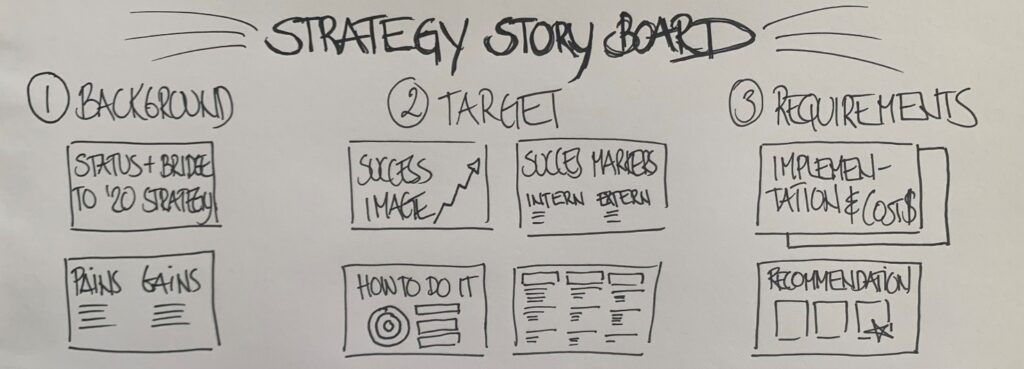
So, we draw up a story board. A table of content if you want. But high level on what we would like our final product to include. It might be as simple as three chapters: 1) Background (e.g., bridge to prior strategy, rationale, analysis) 2) Target (e.g., the ambition of the strategy, how we want to achieve it) and 3) Requirements and Recommendations (e.g., implementation scenarios, WBS/Work-Breakdown-structure, Cost estimate).
When we have drawn up this outline of what we will produce, we start…
Facilitation guide: The following exercises can directly or indirectly prepare us for the next steps
Standing in the future – what does our success look like? (How do we know that we have succeeded?)
Elevator pitch – nailing it now to ensure we keep our optimism going forward
Mood barometer: When we complete this day everyone feels mostly confused, and a bit disheartened at how we will ever turn all of this into a sharp, concise, and ambitious strategy. So, do not wait too long before moving on to day 2&3.
It has been a few days, but the time passed has not been in vain. Our mind has been absorbing and consolidating our output vision. For in the midst of the chaos of different notes and discussions we actually have a clear target and a rough idea of how what our success looks like.
Day 2 & 3: The ‘I think we might actually be on to something here’-days
So, for these two coherent days we start shaping and filling in the empty placeholder slides on our story board.
Facilitation guide:
SWOT – taking a look at our Strength, Weaknesses, Opportunities and Threats is a good way to pick up from day 1 and add structured input.
SMART goals – identify how do we know we have succeeded? (Both internal and external markers).
Focus Areas – differentiate the operational level, the ‘WHAT of what we are doing’. Be careful not to have too many. 4-5 should do.
Tactical efforts – start structuring sub bullets to the focus areas – this is the ‘HOW of what we are doing
Consider if you need ‘Enablers’ ‘Guiding Principles’ or other Core Values that might be a useful other level of the HOW we want to achieve the goals across the focus areas.
Mood barometer: The energy is high. We start to see pieces coming together and structure building up. However, the feeling of ‘how will we ever get there’ is also creeping in as we are almost halfway in. And fair enough. We will never finish in plenary. We need to divide and concur from now on. And we need to start producing the final product.
Day 4: The completely necessary ‘recap and reflect’-day not placed at the end of the process
Today we start turning the different sections into an actual strategy document. The Co-creation feature in SharePoint is highly appreciated at this point. We divide, put on our noise cancellation headphones on and each work on a section for the final document or presentation.
Facilitation guide:
Peace and quit – with frequent scheduled check points
Facts and figures validation – this might be an assignment someone have been asked to prepare in-between, but we need to have someone validating our sources, data, benchmarks, etc.
Mood barometer: The mind is focused, and creativity is needed. We each consider the best way of presenting the sections we are shaping. Some are drawing, some are starring into the air, but everywhere the mind is deeply engaged in thinking each part through. A playfulness with words, phrasing and visualisation is key – and if we are stuck, we know that a brief check point is coming up shortly where we can ask for input.
Day 5: The ‘not as boring as it might seem’ numbers-day
Before we have a full day to deep dive into the calculation of whatever effort is required one of us has spend yet another day preparing the Excel sheets with all the input on the operational and tactical areas, formulas, etc. I like using a homebrewed Work Breakdown Structure-ish template with effort estimation of each activity.
Facilitation guide:
Estimating the time costs – go through each of the activities and estimate when it should be done and how long it will take. Make sure that the document sums up and include some percentage to underestimation (because things ALWAYS take longer) and unforeseen activities (that WILL happen).
Throughout the processes, changes in structure, wording, activities, etc. will happen, and someone will later transfer these updates to the strategy document.
Mood barometer: We get somewhat annoyed with each other for consistently being either too conservative or too time optimistic. Each activity we want to include is quite easily estimated and we agree on when steps can be implemented. But the sum of the estimation is frustrating. We clearly see that the resourced we have will not be enough and it is tempting to cut a bit back on the time estimates and consultant fees to keep the cost down.
However, we need this exercise to find out if the whole thing is worth it. It is free to imagine how we want to aim, but if we are not willing to put our money where our mouth is, we will never succeed with it. So, the right way to slim down the estimate is to make choices of chunks to eliminate rather than underestimating the entire endeavour.
However, we need this exercise to find out if the whole thing is worth it. It is free to imagine how we want to aim, but if we are not willing to put our money where our mouth is, we will never succeed with it. So, the right way to slim down the estimate is to make choices of chunks to eliminate rather than underestimating the entire endeavour.
Day 6: ‘The devil’s advocate’-day
Since day 5 we have been collecting all outstanding input, finalising slides/document sections, illustrations, proof-reading etc. The document looks done and we take yet another round. We might invite a higher-ranking officer to provide feedback, or we take the devil’s advocate role ourselves. But we look at what we have achieved through the eye of our Board, Executives, Program owner or whomever will sanction the strategy. Is there anything they will need? Is there anything they might question?
Facilitation guide: Consider including some of these elements to your presentation
Pros & Cons overview – especially if the strategy holds different scenarios to choose from (glance at SWOT, costs, etc)
Gains & Pains – if we have addressed the pains that we want to address, it is a solid help for decision makers to have a clear overview of which of the pains and which of the pains will be addressed
Recommendations – though decisions makers might not follow your recommendation (for a multitude of reasons) they do appreciate to know the experts’ recommendation
Mood barometer: We feel proud and a bit astonished that this was possible. And also, a bit nervous to be presenting our strategy. We might second guess ourselves. For whom is to say that the thoughts that we came up with are the right ones. The thing is though – there might have been other roads we could have taken. But this one has been solidly thought through and hence it stands a good chance of succeeding.